Although not mandated by law, fairness opinions for significant corporate transactions effectively have been required since 1985 when the Delaware Supreme Court ruled in Smith v. Van Gorkom, (Trans Union), (488 A. 2d Del. 1985) that directors were grossly negligent for approving a merger without sufficient inquiry. The Court suggested directors could have addressed their duty of care (informed decision making) by obtaining a fairness opinion.
Private equity (and credit) advisors sometimes obtain fairness opinions, too. Regulation rather than case law is poised to make fairness opinions required for general partner-led (“GP”) secondary transactions.
On February 9, 2022 the Securities and Exchange Commission proposed changes to the Investment Advisors Act of 1940 (“Advisors Act”) that if finalized would, among other things, require advisor-led secondary transactions to “distribute to investors a fairness opinion and a written summary of certain material business relationships between the advisor and the opinion provider.” A link to the proposal can be found here.
Years ago, investing in an institution backed partnership was equivalent to buying a bond and holding it to maturity; not anymore. Limited partners (“LP”) can obtain liquidity before a fund is liquidated via a secondary market transaction.
Figure 1: GP vs. LP-Led Secondaries
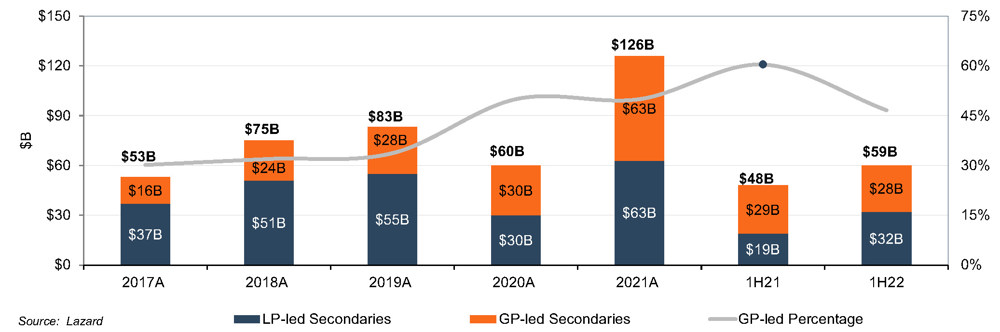
Prior to 2020, the most common liquidity transaction would be for an LP to find a buyer for the interest with the consent of the GP and meet other partnership agreement requirements. In a GP-led deal, the GP initiates a transaction. A common transaction involves a “continuation” fund in which a newly established fund acquires an asset that is not ready to be monetized from a fund that is near the end of its life. LP investors are offered the option to cash out or roll their interest into the continuation fund.
Over the past decade, the ability of LP investors to realize liquidity in a secondary market transaction has risen dramatically with the advent of large secondary funds. As shown in Figure 1, global secondary volume more than doubled in 2021 to $126 billion from $60 billion per estimates compiled by Lazard. Volume could conceivably top 2021 this year based upon a sharp slowdown in M&A and IPO activity as LPs and GPs look to the secondary market for liquidity.
Given the position of GPs on both sides of these transactions, the SEC position is not surprising. It is analogous to the requirement that an independent broker-dealer be used to sell/buy an asset among mutual funds within the same family of funds.
The proposed SEC rule takes aim at the corporate duty of loyalty, which with the duty of care and good faith form the triad that underpins the Business Judgement Rule in which courts defer to the decision making of directors provided they have not violated one of their duties. As far as we know, there has been no widespread finger pointing that GP-led transactions have intentionally disadvantaged LPs. Nonetheless, the SEC proposal is a regulatory means to address the issue of loyalty.
For more information about this topic or to discuss your needs in confidence, don’t hesitate to contact us.
Originally featured in Mercer Capital's Portfolio Valuation Newsletter: Fourth Quarter 2022