Corporate Valuation, Investment Management

February 16, 2021

How RIA Owners Can Rethink Compensation

Money Talks

Salary and bonus discussions are some of the most stressful conversations business owners have each year, and RIA principals are no exception. Since personnel costs are by far the largest expense item on an RIA’s income statement, it is understandable that these principals frequently question (and are questioned about) their compensation decisions. While there is no one-size-fits-all formula for compensation, we have discovered three ways to ease some of the anxiety around these discussions.

1) Define the Philosophy of Your Compensation Model

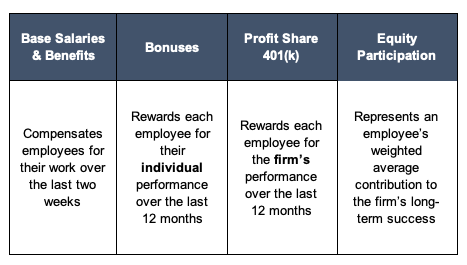
Compensation can do more than simply reimburse your employees for their time, but only if it is well planned and communicated.  A good compensation model can help your company attract, retain, and motivate talent. We often think about compensation in four buckets.
2) Pay Bonuses More Frequently

One benefit of a recurring revenue business is that a firm’s performance can be calculated on a more frequent basis.  Paying bonuses quarterly, or even bi-annually, can take away some of the stress that annual bonus discussions bring.  Additionally, quarterly bonus discussions provide an opportunity to deliver meaningful feedback to your employees on a more regular basis.  Employees do their best work when they feel valued; why not remind them of that more than once a year?

3) Compare Your Margins to Peers

While there is significant variation in how RIA owners think about compensating their employees (and themselves), there is some uniformity across the industry as to how much RIAs should pay out in total compensation.  As shown below, publicly traded RIAs with under $100 billion in AUM pay out roughly half of revenue as compensation.
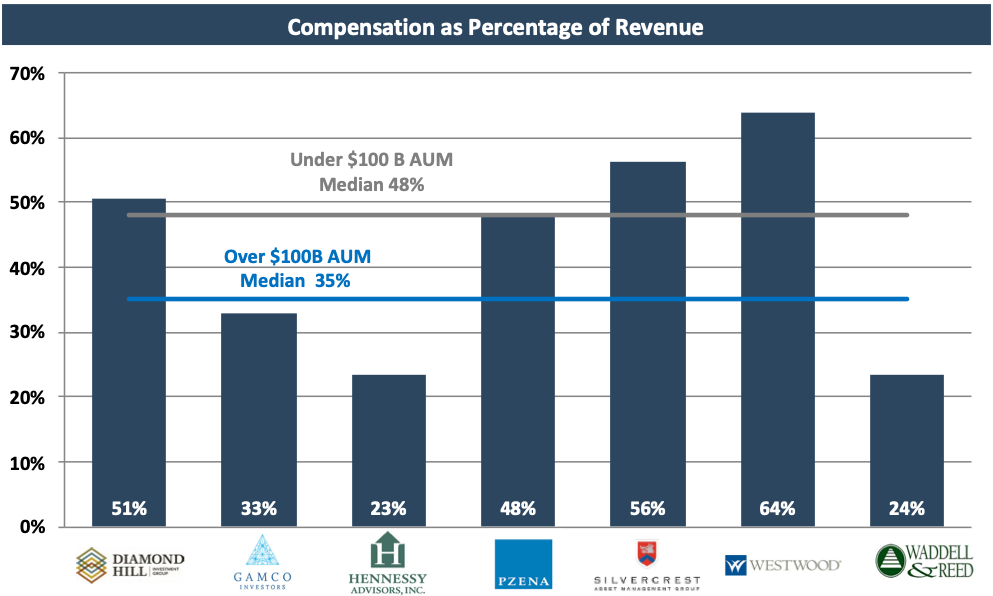
Considering this metric along with typical operating margins for RIAs (usually 20% to 30% depending on size, type, and location) can help you gauge whether your compensation expenses are in sync with the market. To learn more about more on common compensation questions join us atRIA Practice Management Insights, as Matt Crow and I spend a half-hour answering your question about RIA compensation practices.

Only 2 WEEKS until the RIA Practice Management Insights conference begins!

Mercer Capital has organized a virtual conference for RIAs that is focused entirely on operational issues – from staffing to branding to technology to culture – issues that are as easy to ignore as they are vital to success. The RIA Practice Management Insights conference will be a two half-day, virtual conference held on March 3 and 4.

Join us and speakers like Jim Grant, Peter Nesvold, Matt Sonnen, and Meg Carpenter, among others, at the RIA Practice Management Insights, a conference unlike any other in the industry.

Have you registered yet?
Continue Reading

Mercer Capital to Sponsor the Association of Trust Organizations 2026 Annual Meeting
Mercer Capital is pleased to sponsor the Association of Trust Organizations’ 2026 Annual Meeting, taking place September 21-23, 2026, at the Grand Hyatt Deer Valley in Park City, Utah. Matt Crow, Brooks Hamner, and Zach Milam will attend on behalf of the firm.The 2026 Annual Meeting is a 1.5-day conference designed exclusively for the trust industry and will feature more than 13 hours of roundtables, panels, and networking. One of the featured sessions is Tuesday afternoon’s Session VI, “What Makes a Trust Company Worth More? Building Value Before the Deal,” which will be moderated by Matt Crow. The panel will explore the factors that drive valuation, how buyers and sellers evaluate opportunities, and what firms can do today to maximize enterprise value.Matt Crow, CFA, ASA, is the CEO of Mercer Capital and leads the firm’s Investment Management Industry team. He works with RIAs, independent trust companies, broker-dealers, and investment consulting firms on valuation matters related to corporate planning and reorganization, transactions, employee stock ownership plans, tax issues, and intangible asset valuations. Matt is also a frequent contributor to Mercer Capital’s RIA Valuation Insights blog.Brooks Hamner, CFA, ASA, is a Senior Vice President and a senior member of Mercer Capital’s Investment Management Industry team. He provides valuation services to RIAs, independent trust companies, asset managers, wealth management firms, broker-dealers, and investment consultants, and he also advises clients buying or selling their business.Zach Milam, CFA, is a Vice President and a senior member of Mercer Capital’s Investment Management Industry team. He has experience in corporate planning and reorganizations, financial reporting, fairness opinions, litigation support, employee stock ownership plans, and estate and gift tax planning and compliance matters.Mercer Capital regularly works with RIAs, independent trust companies, broker-dealers, and other investment management clients on valuation and advisory matters, and the firm looks forward to connecting with attendees in Park City. Visit the conference website to learn more about this year’s Annual Meeting: https://trustorgs.com/annual-meeting/.
The Margin RIA Buyers Actually Underwrite

Why the Post-Closing Cost Structure Matters More Than the Historical Margin

RIA buyers often focus less on a seller’s historical margin than on the earnings the business can generate after closing under the buyer’s operating model. Differences in integration strategy, cost structure, and platform capabilities can lead buyers to underwrite materially different margins and values.
RIA Valuation Insights Blog Investment Management
Read Now about The Margin RIA Buyers Actually Underwrite
Does AI Spending Increase an RIA’s Value-or Just Reduce Its EBITDA?
Does AI Spending Increase an RIA’s Value - or Just Reduce Its EBITDA?
AI investment can create value for RIAs by improving capacity, growth, efficiency, and risk management, but the benefits must ultimately translate into stronger cash flow or reduced risk. Recurring AI costs generally remain operating expenses, making measurable adoption and returns critical to valuation.

Cart

Your cart is empty