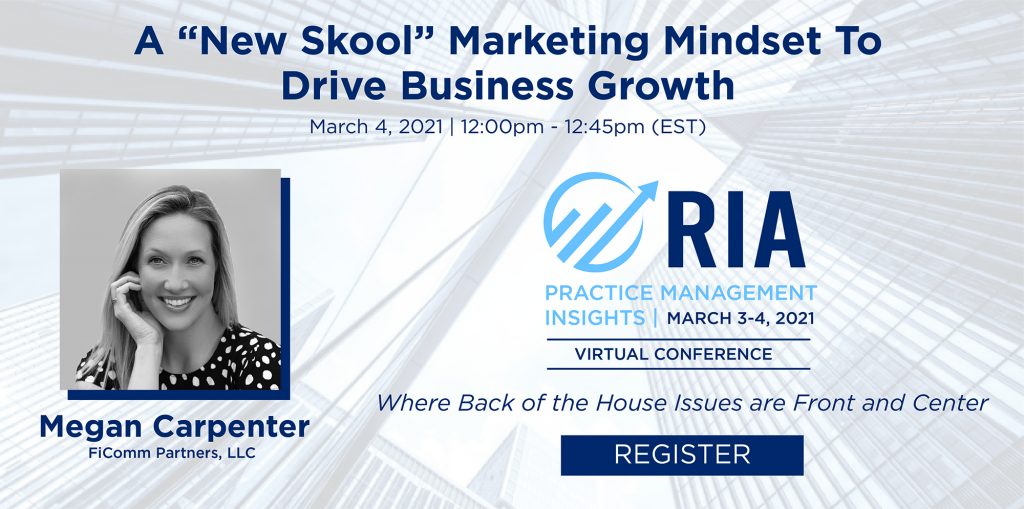
Over the years, we have repeatedly said that the wealth management side of the investment management business is healthier than the asset management side. Unlike asset managers whose clients are likely to jump ship after a few bad quarters, wealth management is based on client relationships and a manager’s ability to inspire confidence in his or her clients. Wealth managers spent their careers perfecting in-person communications to connect with clients. 2020’s transition to WFH made most of these communications virtual. In this post, Megan Carpenter provides tips to improve your Zoom communication skills with clients.Megan Carpenter helps RIA firms and advisors connect, communicate, and engage effectively with their target audiences She will be speaking about the role of marketing in delivering commercial outcomes at our upcoming RIA Practice Management Insights conference to be held March 3-4. Register now to hear more Megan Carpenter along with keynotes from James Grant, founder and editor of Grant’s Interest Rate Observer, and industry veteran Peter Nesvold, Managing Director of Nesvold Capital Partners.
The year 2020 knocked a lot of old traditions off their pedestals—including the ways people connect with each other. Now, you don’t even need to be in the same room to sustain a relationship anymore. A video app is enough.
The problem is, you spent years becoming a superstar at in-person communications—learning to press the flesh, read a room and translate body language. Can you learn to translate those skills to a screen, and be just as engaging on video?
Fortunately, the answer is yes. But first, you need to commit to doing three things: Be vulnerable. Practice hard. And learn from your peers.
Be vulnerable: It’s what makes you human.
On video, it’s easy to spot the difference between honesty and pretense. A newbie might sit bolt upright at his desk in a suit and tie like a sportscaster, leaving the audience wondering if he forgot he’s at home. Someone more comfortable might lean to the side and smile, welcoming you into her living room like she’s about to serve tea.
What you say is even more important than how you look. If you’re guarded, everything sounds like corporate happy-talk. For example, we run video DIY workshops for advisors. For one assignment, we asked attendees to make videos about working from home. Most were predictable, boasting about successful transitions or a smooth client process. Out of nowhere, one advisor said, “I realized I’ve never given myself permission to work from home, even though I’m more productive here. I’ve put all of that on myself.” That one crack of honesty in the wall opened up a flood of deeper conversation.
Some concrete tips for bringing vulnerability into your communications include:
Don’t overproduce; be human
Speak to one person, not an imaginary audience
Keep your background simple but relatable
If you forget to mention something while speaking, don’t start again. Just say “Oh, I forgot,” as if you were talking to a friend
Share your thought process, and explain how your thinking has matured
Practice hard: Being “natural” takes work.
It's an oxymoron, but it’s true: If you want to be yourself on camera, you have to learn how. And not just learn it, but practice it. It’s taken you a lifetime to master the art of walking confidently into a room and building a human connection. You’re can’t expect to master doing it on video overnight. These skills aren’t intuitive; they have to be rehearsed. Shoot video regularly, get feedback, recalibrate and try again. If you want more guidance and support, consider signing up for workshops or coaching sessions.
Learn from other advisors: You don’t have to go it alone.
In fact, you can’t go at it alone. You need give-and-take to learn how to connect remotely. The good news is, being vulnerable is a lot less scary when you see your peers doing the same thing. There’s comfort in watching other advisors emerge from their shells, support each other, and feel supported in return. That’s another reason why workshops are ideal for learning video skills.
It’s a new world out there. Old voices are losing influence, and new leaders in branding and communications are emerging. If you want to become a video superstar, you have to commit yourself to learning and growing. You don’t have to be perfect. You just have to be willing to break down old habits, listen to others, and stick with your journey.
Originally published in WM.com Midyear Outlook
About the Author
Megan is CEO and Co-Founder of FiComm Partners, an award-winning agency for RIA firms and financial advisors.
Recently named to the Investment News "40 Under 40" list, Meg’s expertise spans over 15 years of helping RIA firms and advisors connect, communicate and engage effectively with their target audiences. Her passion to promote the industry is demonstrated through her involvement with the CFP Board Center for Financial Planning Workforce Development Advisory Group.
We’re excited to have Megan speak at our inaugural RIA Practice Management Insights conference.