Family Business Advisory Services

June 8, 2020

What Is a “Level” of Value, and Why Does it Matter? (Part 3)

In last week’s post, we demonstrated how critical getting the level of value right is for family businesses for estate planning, acquisitions, and divestitures. We conclude our series on the levels of value this week, by turning our attention to shareholder redemption transactions.

Shareholder Redemptions

A shareholder redemption is a purchase by the family business of shares from a family shareholder.  As with our corporate development and divestiture examples from last week’s post, shareholder redemptions reflect an inherent tension between buyers and sellers, as illustrated in Exhibit 1.
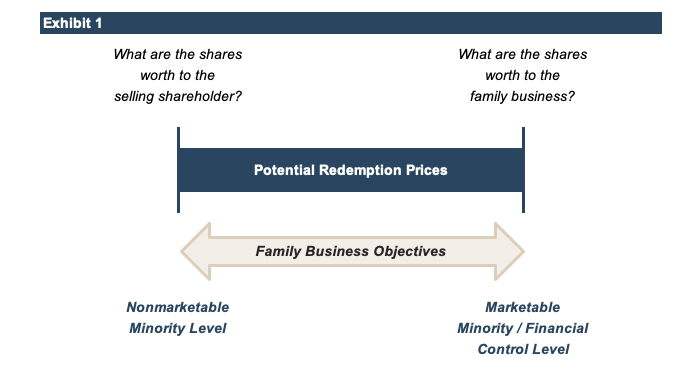
In a shareholder redemption transaction, the buyer and seller do not share the same perspective.

  • The selling shareholder owns an illiquid minority interest in a private business. As a result, the fair market value – the amount that a hypothetical willing buyer would pay – reflects a marketability discount.  In other words, the nonmarketable minority level is relevant.
  • However, in a shareholder redemption transaction, the buyer is not a hypothetical party, but the company that issued the shares in the first place. The family business is not burdened by the illiquidity of the shares in the same way a shareholder is.  As a result, the value of the shares to the family business is consistent with the marketable minority level of value.
It strikes us as a bit perverse to evaluate transactions between family shareholders and family businesses in terms of relative negotiating leverage.  Instead, we prefer to frame the decision in terms of family business objectives: What is the purpose of the redemption? The “correct” price at which to conduct a shareholder redemption transaction is always a bit ambiguous.  Consider the alternatives:
  • Nonmarketable Minority Level. This seems straightforward – after all, that is the fair market value of what the shareholder owns.  Why should the family business pay any more than that?
  • Marketable Minority Level. On the other hand, this is the value of what the redeeming company is acquiring.  Why should the family business pay any less than that?
From an economic perspective, a redemption at the nonmarketable minority level is accretive to the non-selling shareholders.  Redeeming at the marketable minority level provides a windfall to the selling shareholder relative to the fair market value of their shares.  There is no simple escape from this dilemma.
  • If the family business wants to discourage redemption requests, the nonmarketable minority level of value may be preferable.
  • If the family business is designing a shareholder liquidity program with a view to promoting positive shareholder engagement, it may be desirable to conduct redemptions at the marketable minority level of value. However, in such cases it is essential to set limits on the amount of redemption requests the family business will honor in a given period; otherwise, the liquidity program could trigger a “run on the bank,” crowding out corporate investments critical to the long-term sustainability of the family business.
  • If the objective of the redemption is to “prune” the family tree of unwanted branches, it may be necessary to pay a redemption price at the marketable minority / financial control level of value. Depending on state statute, it may be a legal necessity.  In any event, the departing shareholders are likely to demand such pricing to exit the family business.

Conclusion

In this series of posts, we have explained what the levels of value mean.  Your family business has a different value at each level of value because of differences in expected cash flows and risk factors.  Considering four common corporate transactions, we have illustrated why the level of value matters to family businesses:

  • When transferring minority interests among family members in furtherance of estate planning objectives, the fair market value of the interests transferred is properly measured at the nonmarketable minority level.
  • When considering a potential acquisition, family businesses should evaluate both the marketable minority / financial control level of value (what the target is worth to the existing owners) and the potential strategic control level of value (what the target is worth to the family business). These two values for the target define the relevant range for negotiating a transaction price.
  • When divesting a business, the dynamics are reversed. The relevant negotiating range is set by the difference between the marketable minority / financial control level of value (in this case, what the business is worth to the family) and the strategic control level of value (what the business is potentially worth to the buyer).  The family can improve its negotiating leverage in these situations by differentiating the business from other available targets and exposing the business to multiple motivated buyers.
  • Finally, shareholder redemptions can occur at either the nonmarketable minority or marketable / minority financial control levels of value. The appropriate level for a given transaction should be selected with a view to the objectives of the redemption for the family business.
These transactions can have profound and long-lasting economic implications for the family business and its shareholders.  When the stakes are high, it’s a good idea to measure twice and cut once.  When your family business is preparing for any of these transactions, give one of our valuation professionals a call.
See Part 1 of this series here. See Part 2 of this series here.

Continue Reading

How Should Family Business Directors Use Benchmarking Data?
Family business directors can use benchmarking data more effectively by pairing a focused set of performance measures with relevant peer comparisons. Consistent review over time helps boards identify meaningful trends, understand performance gaps, and assess whether results align with company strategy and shareholder priorities.
Mercer Capital Sponsoring and Speaking at the 5th Annual It’s All Relative Family Business Symposium
Mercer Capital is pleased to sponsor the 5th annual It’s All Relative Family Business Symposium, hosted by the Ole Miss Center for Innovation and Entrepreneurship. The 2026 program will focus on governance and boards, with sessions designed to help family business leaders think more strategically about structure, stewardship, and long-term continuity.The Symposium takes place September 15-16, 2026, in Flowood, Mississippi. Travis Harms, Tripp Crews, and Zac Lange will represent the firm at the Symposium.In addition, Travis Harms and Tripp Crews are also leading the Tuesday afternoon session on “Dividend and Redemption Policies,” which explores how family businesses can balance shareholder liquidity needs with the capital required to support the long-term health of the business.Travis Harms, CFA, CPA, ABV, is President of Mercer Capital and leads the firm’s Family Business Advisory Services Group. He focuses on financial education, valuation, and strategic financial consulting for multigenerational family businesses.Tripp Crews, ABV, is a Vice President with Mercer Capital and serves on the firm’s Transaction Advisory Services team, the Agribusiness Industry team, and the Family Business Advisory Services Group. He works on valuation and transaction-related matters for closely held businesses and family enterprises, with particular experience in agribusiness and ownership transition issues.Zac Lange, CPA, ABV, is a Vice President with Mercer Capital and serves on the firm’s Family Business Advisory Services Group. He focuses on supporting family businesses and litigants with valuation, financial analysis, and dispute-related matters, including corporate planning and reorganizations, financial reporting, and fairness opinions.Mercer Capital regularly works with family business owners and advisors on valuation and strategic financial matters involving ownership, governance, succession, and long-term planning. The firm is proud to support programs that bring family business leaders together for practical discussion and shared learning.Mercer Capital looks forward to connecting with attendees in Flowood and participating in this year’s Symposium. To learn more about the symposium, visit the event's website: https://olemisscie.com/family-business-26/
When Was the Last Time Anyone Read the Buy-Sell Agreement?

You Asked. We Answer.

Periodic review of a family business’s buy-sell agreement can reveal whether its valuation, liquidity, and transfer provisions still align with current shareholder expectations and financial realities. Testing the agreement through a hypothetical triggering event can help identify potential conflicts before they become costly disputes.

Cart

Your cart is empty