Corporate Valuation, Oil & Gas
shutterstock_1152341723.jpg

April 5, 2021

Eagle Ford Benefits From Commodity Price Increases Despite Challenges

The economics of oil and gas production vary by region. Mercer Capital focuses on trends in the Eagle Ford, Permian, Bakken, and Marcellus and Utica plays. The cost of producing oil and gas depends on the geological makeup of the reserve, depth of reserve, and cost to transport the raw crude to market. We can observe different costs in different regions depending on these factors. This quarter we take a closer look at the Eagle Ford.

Production and Activity Levels

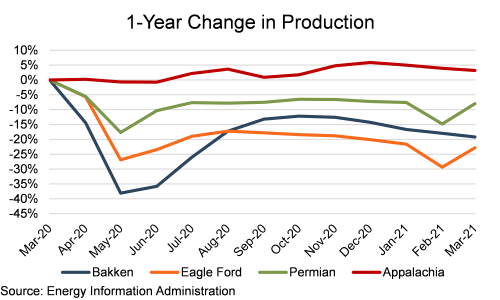
Estimated Eagle Ford production declined approximately 23% year-over-year through March.  This is the most severe decline observed for all of Mercer Capital’s coverage areas, with production in the Bakken, Permian, and Appalachia down 19%, down 8%, and up 3%, respectively.  In the immediate aftermath of the Saudi/Russian price war and historic rout in oil prices, the Eagle Ford’s production decline was less severe than what was seen in the Bakken, though the rebound in the Eagle Ford was also more muted.  During the fourth quarter of 2020, Eagle Ford production trended downward once again and appears to have been materially impacted in February 2021 by the cold weather that disrupted power supplies throughout Texas.
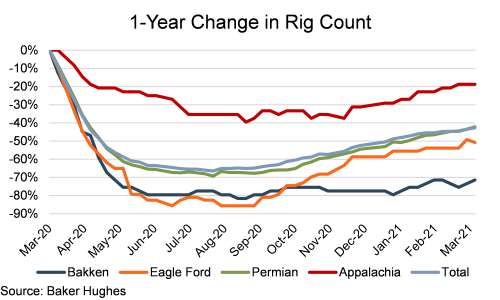
However, the Eagle Ford’s rig count has generally been rising over the past six months.  Total rigs in the Eagle Ford stood at 31 as of March 26, down over 50% from the prior year, but more than 3x higher than the low of 9 rigs observed in September 2020.  Bakken, Permian, and Appalachia rig counts were down 71%, 42%, and 19% year-over-year, though have all rebounded from the September lows (though not as dramatically as the Eagle Ford’s rise since then). While recent data has been noisy, and the Eagle Ford’s current rig count should keep production relatively flat, based on legacy production declines and new-well production per rig.
Commodity Prices Stabilize, Though Uncertain Demand Dynamics Remain

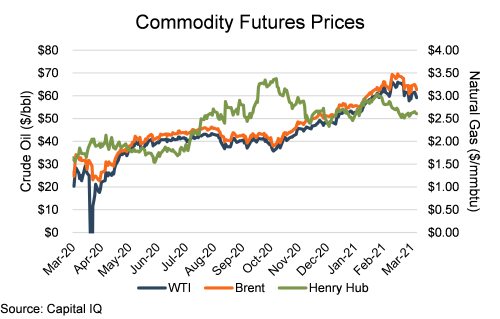
The first quarter of 2021 was relatively good for commodity prices, though they exhibited more volatility than in recent quarters.  Front-month WTI futures began the quarter at ~$48/bbl and increased to a peak of $66/bbl before ending the quarter at ~$59/bbl.  Henry Hub natural gas front-month futures prices broke above $3/mmbtu in February 2021, though regional spot prices were much more volatile as cold weather disrupted gas production and transmission while also increasing demand for heat and electricity.
Financial Performance

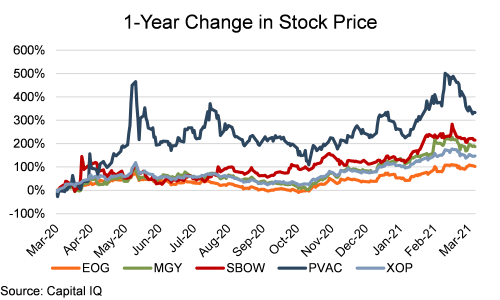
The Eagle Ford public comp group had a banner year for stock price performance over the past twelve months, with Penn Virginia, Silverbow, Mongolia, and EOG up 334%, 215%, 187%, and 102%, respectively.  All except EOG outperformed the broader E&P sector, as proxied by XOP (which was up 157% during the past twelve months).  However, that stock price performance is largely driven by the exceptionally low starting point in March 2020, as the Saudi/Russian price war and reduced demand due to COVID-19 lockdowns created significant concern among investors regarding the financial position of E&P companies, especially those with significant leverage.  Stock prices for the four companies remain below all-time highs.
EOG Doubles Down on “Double Premium” Locations

In their Q4 2020 earnings call and presentation, EOG touted its inventory of “Double Premium” locations, which meet EOG’s new return hurdle of 60% Direct After-Tax Rate of Return (ATROR) at $40 oil and $2.50 natural gas.  While not clearly defined, EOG describes Direct ATROR as including “the costs associated with drilling and completion operations and well site facilities.”  All-In ATROR, which is more akin to a full-cycle calculation, “includes such costs as well as (i) the costs associated with other facilities, lease acquisitions, delay rentals and gathering and processing operations and (ii) geological and geophysical costs, exploration G&A costs, capitalized interest and other miscellaneous costs.”  Per EOG’s presentation, roughly half of EOG’s 11,500 premium locations fit the underwriting criteria to be classified as “double premium.”

However, E&P companies have long been criticized for touting well-level IRRs and other bespoke financial metrics that imply phenomenal economics, but don’t seem to result in corresponding corporate-level returns. We’ll see if EOG’s more stringent underwriting standards translate to shareholder returns.

Conclusion

The Eagle Ford was among the regions hardest hit by low commodity prices.  The recent increase in rig count bodes well for stemming production declines, though more rigs are likely needed for material production growth given natural declines in existing production.  However, with investors and E&P management teams focused on returns rather than growth, current commodity prices may not lead to the expansion in the activity that’s been seen in previous cycles.

We have assisted many clients with various valuation needs in the upstream oil and gas space for both conventional and unconventional plays in North America, and around the world.  Contact a Mercer Capital professional to discuss your needs in confidence and learn more about how we can help you succeed.

Continue Reading

Defying the Cycle: Haynesville Production Strength in a Shifting Gas Market
Haynesville shale production defied broader market softness in 2025, leading major U.S. basins with double-digit year-over-year growth despite heightened volatility and sub-cycle drilling activity. Efficiency gains, DUC drawdowns, and Gulf Coast demand dynamics allowed operators to sustain output even as natural gas prices fluctuated sharply.
Haynesville Shale M&A Update: 2025 in Review
Key TakeawaysHaynesville remains a strategic LNG-linked basin. 2025 transactions emphasized long-duration natural gas exposure and proximity to Gulf Coast export infrastructure, reinforcing the basin’s importance in meeting global LNG demand.International utilities drove much of the activity. Japanese power and gas companies pursued direct upstream ownership, signaling a shift from traditional offtake agreements toward greater control over U.S. gas supply.M&A was selective but meaningful in scale and intent. While overall deal volume was limited, announced transactions and reported negotiations reflected deliberate, long-term positioning rather than opportunistic shale consolidation.OverviewM&A activity in the Haynesville Shale during 2025 was marked by strategic, LNG-linked transactions and renewed international investor interest in U.S. natural gas assets. While investors remained selective relative to prior shale upcycles, transactions that did occur reflected a clear pattern: buyers focused on long-duration gas exposure, scale, and proximity to Gulf Coast export markets rather than short-term development upside.Producers and capital providers increasingly refocused efforts on the Haynesville basin during the year, including raising capital to acquire both operating assets and mineral positions. This renewed attention followed a period of subdued transaction activity and underscored the basin’s continued relevance within global natural gas portfolios.Although the Haynesville did not experience the breadth of consolidation seen in some oil-weighted plays, the size, counterparties, and strategic motivations behind 2025 transactions reinforced the basin’s role as a long-term supply source for LNG-linked demand.Announced Upstream TransactionsTokyo Gas (TG Natural Resources) / ChevronIn April 2025, Tokyo Gas Co., through its U.S. joint venture TG Natural Resources, entered into an agreement to acquire a 70% interest in Chevron’s East Texas natural gas assets for $525 million. The assets include significant Haynesville exposure and were acquired through a combination of cash consideration and capital commitments.The transaction was characterized as part of Tokyo Gas’s broader strategy to secure long-term U.S. natural gas supply and expand its upstream footprint. The deal reflects a growing trend among international utilities to obtain direct exposure to U.S. shale gas through ownership interests rather than relying solely on long-term offtake contracts or third-party supply arrangements.From an M&A perspective, the transaction highlights continued willingness among major operators to monetize non-core or minority positions while retaining operational involvement, and it underscores the Haynesville’s attractiveness to buyers with a long-term, strategic view of gas demand.JERA / Williams & GEP Haynesville IIIn October 2025, JERA Co., Japan’s largest power generator, announced an agreement to acquire Haynesville shale gas production assets from Williams Companies and GEP Haynesville II, a joint venture between GeoSouthern Energy and Blackstone. The transaction was valued at approximately $1.5 billion.This acquisition marked JERA’s first direct investment in U.S. shale gas production, representing a notable expansion of the company’s upstream exposure and reinforcing JERA’s interest in securing supply from regions with strong connectivity to U.S. LNG export infrastructure.This transaction further illustrates the appeal of the Haynesville to international buyers seeking stable, scalable gas assets and highlights the role of upstream M&A as a tool for portfolio diversification among global utilities and energy companies.Reported Negotiations (Not Announced)Mitsubishi / Aethon Energy ManagementIn June 2025, Reuters reported that Mitsubishi Corp. was in discussions to acquire Aethon Energy Management, a privately held operator with substantial Haynesville production and midstream assets. The potential transaction was reported to be valued at approximately $8 billion, though Reuters emphasized that talks were ongoing and that no deal had been finalized at the time.While the transaction was not announced during 2025, the reported discussions were notable for both their scale and the identity of the potential buyer. Aethon has long been viewed as one of the largest private platforms in the Haynesville, and any transaction involving the company would represent a significant consolidation event within the basin.The reported talks underscored the depth of international interest in Haynesville-oriented platforms and highlighted the potential for large-scale transactions even in an otherwise measured M&A environment.ConclusionWhile overall deal volume remained selective, the transactions and reported negotiations in 2025 reflected sustained global interest in U.S. natural gas assets with long-term relevance. Collectively, the transactions and negotiations discussed above point to a Haynesville M&A landscape driven less by opportunistic consolidation and more by deliberate, long-term positioning. As global energy portfolios continue to evolve, the Haynesville basin remains a focal point for strategic investment, particularly for buyers seeking exposure tied to U.S. natural gas supply and LNG export linkages.
Mineral Aggregator Valuation Multiples Study Released-Data as of 06-11-2025
Mineral Aggregator Valuation Multiples Study Released

With Market Data as of June 11, 2025

Mercer Capital has thoughtfully analyzed the corporate and capital structures of the publicly traded mineral aggregators to derive meaningful indications of enterprise value. We have also calculated valuation multiples based on a variety of metrics, including distributions and reserves, as well as earnings and production on both a historical and forward-looking basis.

Cart

Your cart is empty