Corporate Valuation, Financial Services

December 9, 2020

Estate Planning When Bank Stocks Are Depressed

Maybe not for the best of reasons, the stars have aligned for bank investors who have significant interests in banks to undertake robust estate planning this year.

Bank stock valuations are depressed as a result of the recession that developed from the COVID-19 policy responses, including a return to a zero interest rate policy (“ZIRP”) that is now known as the effective lower bound (“ELB”). The result is severe compression in net interest margins (“NIMs”), while the extent of credit losses will not be known until 2021 or perhaps even 2022.

As shown in Figure 1, bank stocks have produced a negative total return that ranges from -27% for the twelve months ended September 25, 2020 for the SNL Large Cap Bank Index to -36% for the SNL Mid Cap Bank Index. At the other extreme are tech stocks. The NASDAQ Composite has produced a one-year total return of 35%–a 70% spread between the two sectors.
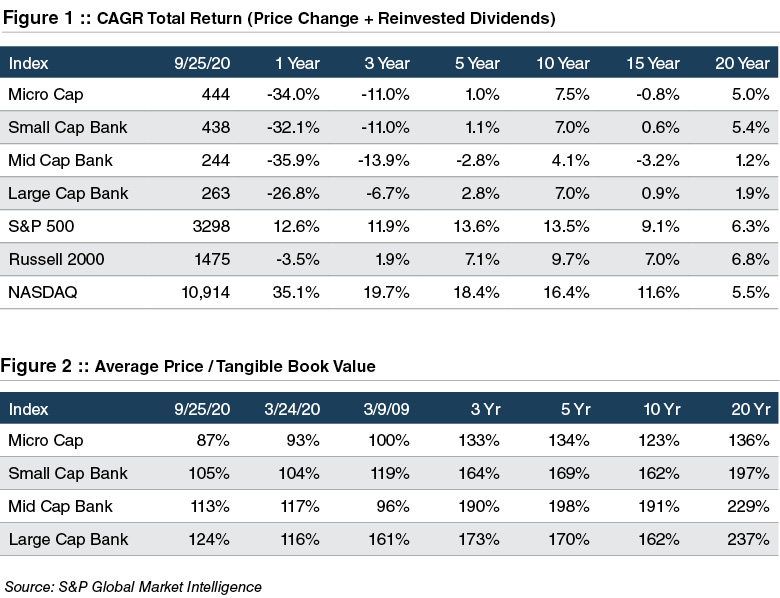
Valuations for banks are depressed and are comparable to lows observed on March 24, 2020 when market panic and forced selling by levered investors peaked and March 9, 2009 when investors feared a possible nationalization of the large banks. Price-to-tangible book value (“P/TBV”) multiples are presented in Figure 2, while price-to-earnings (“P/E”) ratios based upon the last 12-month (“LTM”) earnings are presented in Figure 3.(Note—while P/TBV multiples are little changed from March 24, 2020, P/E ratios have increased because reserve building and reduced NIMs have reduced LTM earnings).
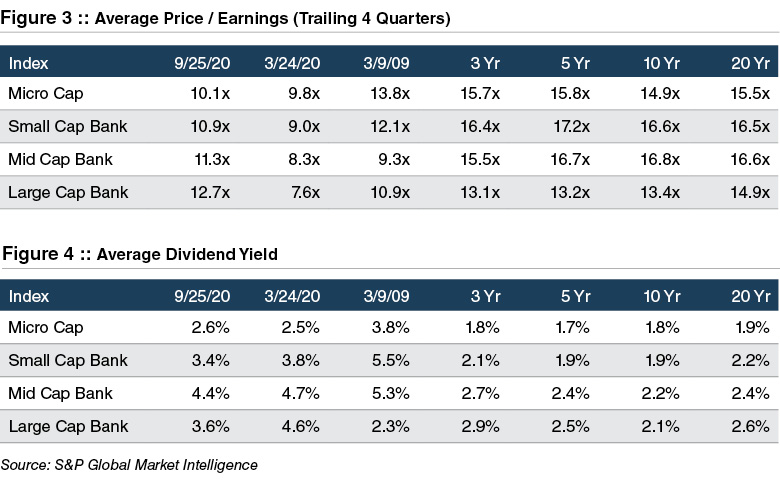
No one knows the future, but assuming reversion to the mean eventually occurs bank stocks could rally as earnings improve once credit costs decline even if NIMs remain depressed, resulting in higher earnings and multiple expansion. Relative to ten-year average multiples based upon daily observations, banks are 30-40% cheap to their post-Great Financial Crisis trading history.

In effect, current gifting and other estate planning could lock in significant tax benefits assuming a Japan and Europe scenario does not develop in the U.S. where banks are “re-rated” and underperform for decades.

A second reason to consider significant estate planning transactions this year is the potential change in Washington if 2021 sees a Biden Administration backstopped with a Democrat-controlled Senate and House.

Vice President Biden’s proposed estate tax changes include the elimination of basis step-up, significant reductions to the unified credit (the amount of wealth that passes tax-free from estate to beneficiary) and gift tax exemption, and increasing current capital gains tax rates to ordinary income levels for high earning households.The cumulative effect of these changes is a substantial increase in high net worth clients’ estate tax liabilities if Biden’s current proposals become law.

Basis step-up is a subtle but important feature of tax law.Unusual among industrialized nations, in the United States the assets in an estate pass to heirs at a tax value established at death (or at an alternate valuation date).Even though no tax is collected on the first $11.6 million per person, the tax basis for the heir is “stepped-up” to the new value established at death.Other countries handle this issue differently, and Biden favors eliminating the step-up in tax basis.Further, he prefers taxing the embedded capital gain at death.Canada, for example, does this – treating a bequest as any other transfer and assessing capital gains taxes to the estate of the decedent.

Fortunately, there are several things bank shareholders can do now to minimize exposure to these potential tax law changes.Taking advantage of the current high-level of gift tax exemptions ($11.58 million per individual or $23.16 million per married couple) could save millions in taxes if Biden’s proposed lower exemption of $3.5 million per individual becomes law. 

Other options include the formation of trusts or asset holding entities to transfer wealth to the next generation in a tax-efficient manner.Proper estate planning can mitigate the adverse effects of higher taxes on wealth transfers, but the window to do so may be closing if we have a regime change later this year.

Further, the demand (and associated cost) for estate planning services may go up significantly in November, so you need to apprise your clients of these potential changes before it’s too late.

In the 1990s, the unified credit (the amount of wealth that passes tax-free from estate to beneficiary) was only $650 thousand, or $1.3 million for a married couple.The unified credit was not indexed for inflation, and the threshold for owing taxes was so low that many families we now consider “mass-affluent” engaged in sophisticated estate tax planning techniques to minimize their liability.

Then in 2000, George W. Bush was elected President, and estate taxes were to be phased out.Over the past decade, the law has changed several times, but mostly to the benefit of wealthier estates.That $650 thousand exemption from estate taxes is now $11.6 million.A married couple would need a net worth of almost $25 million before owing any estate tax, such that now only a sliver of bank stock investors require heavy duty tax planning.

That may all be about to change. 

Vice President Biden has more than gestured that he plans to increase estate taxes by lowering the unified credit, raising rates, and potentially eliminating the step-up in basis that has long been a feature of tax law in the United States.

Talk is cheap. But investors take heed; now may be the time to execute rather than plan.


Originally appeared in Mercer Capital’s Bank Watch, September 2020.

Continue Reading

April 2026 | The Community Bank Scale Tax: Three Questions for Boards in 2026
Bank Watch: April 2026

The Community Bank Scale Tax: Three Questions for Boards in 2026

Community banks came into 2026 in better shape than many expected. Margins and earnings improved, deposits were growing again, loan growth held up, and unrealized losses on securities moved lower. On the surface, the story looks better than a year ago. But that does not mean the pressure is gone.For many community banks, the next big issue is not only rates or loan growth. It is whether the bank is big enough, focused enough, and efficient enough to carry the higher cost of being a modern bank. That cost includes more than salaries and branches. It also includes technology, cybersecurity, vendor management, fraud tools, compliance, and the people needed to run it well. The FDIC’s Quarterly Banking Profile shows that despite better net interest margins, the largest drag on earnings is the cost of running a modern bank.That is where many board conversations should be headed now. The challenge is simple to describe: banking keeps getting more expensive, the cost base is harder to flex, and smaller banks do not always have enough scale to spread those costs out. This does not mean every bank needs to sell but it does mean every bank needs to be honest about what it costs to stay independent.1. Which costs are truly fixed, and which ones are self-inflicted?Every bank has unavoidable costs for non-revenue generating activities, such as for risk management, compliance, and cybersecurity. But not every cost deserves the same treatment.Some banks are carrying real fixed costs. Others are carrying years of built-up complexity: too many vendors, too many products, too many exceptions, too many legacy processes, and too many branches doing less work than they used to.The distinction between real fixed costs and the just-as-real complexity costs matters. If management treats every expense as untouchable, the bank usually ends up protecting complexity instead of protecting value. Boards should push on that point. Which costs are now part of the price of doing business? And which costs are there because nobody has made the harder cleanup decisions? Those are two very different problems.2. Are we big enough, or focused enough, to make the model work?Scale matters in banking, which is not a new point. The part that often gets missed is that scale does not always have to come from simply getting bigger. Scale can come from size. It can also come from focus.A bank with a strong niche, an efficient branch footprint, a manageable product set, and good expense discipline can often perform better than a larger bank carrying too much overhead. Bigger is not always better if the added size comes with added complexity.That is an important point for community bank boards. The question is not just, “Do we need to grow?” The better question is, “Do we have a business model that can carry the cost structure we have today?” If the answer is no, the bank has a few options: it can grow, it can simplify, it can narrow its focus, it can outsource more of what does not set it apart, or it can decide that another partner may be better positioned to carry the platform going forward.Recent examples show the range of choices. Community Bank used a branch purchase from Santander to build scale in a target market; Five Star Bank’s parent chose to wind down BaaS and refocus on its core franchise; Mechanics Bank exited indirect auto and later outsourced servicing of the run-off portfolio; and Susquehanna chose to partner with C&N for greater scale, resiliency, and efficiency. In sum, there are plenty of proven options and choices.But doing nothing is also a choice. And in many cases, it is the most expensive one.3. How much does the expense base hurt shareholder value?This is where strategy turns into valuation. A bank is not credited just for spending money on technology, compliance, or infrastructure. It gets credited when those investments lead to better performance, better returns, better customer retention, better growth, and better risk control.If the bank carries a heavy cost base without a clear payoff, that usually shows up in weaker earnings and lower returns. Over time, it can also show up in a lower valuation, which matters even if the board has no near-term interest in selling. Valuation is not just about a sale; it is a scorecard on the strength of the franchise. A bank with strong returns and a clear strategy usually has more flexibility. A bank with weaker returns and too much complexity usually has fewer options.Timing matters. Banks have more breathing room now than they did a few years ago when interest rates increased sharply, with strong earnings and clean asset quality, and that is a good time to revisit strategic and technological plans.The issue in 2026 is not simply whether a community bank can remain independent. The issue is whether it can earn that independence after paying the ever-growing cost of being a modern bank.The banks that will stand out are not necessarily the biggest banks. They are the ones that know what they do well, run a cleaner model, and make sure their cost base supports the franchise instead of weighing it down. For some institutions, that will support long-term independence. For others, it may lead to a different conclusion.Either way, the discussion should start with a hard look at the expense base. In a lot of cases, the pressure to sell does not begin with a buyer showing up. It begins when the math stops working.About Mercer CapitalMercer Capital is a nationally recognized valuation and advisory firm serving financial institutions including banks, credit unions, fintech companies, insurance companies, investment management firms, financial sponsors, and other specialty finance firms. Mercer Capital regularly assists these clients with significant corporate valuation requirements, transactional advisory services, and other strategic decisions.
Mercer Capital to Attend and Speak at the 38th Annual ABA RPTE National CLE Conference
Mercer Capital will attend and participate in the 38th Annual American Bar Association Real Property, Trust and Estate (RPTE) National CLE Conference, held April 29–May 1, 2026, in Chicago, IL, at the Loews Hotel. Travis Harms and Tim Bronza will represent the firm, with Harms also participating as a speaker.The RPTE National CLE Conference is one of the ABA’s flagship gatherings for real property and estate planning professionals, bringing together attorneys and advisors for several days of in-person education and discussion. Topics this year range from estate and gift tax planning and charitable strategies involving closely held businesses to real estate transactions and fiduciary considerations, with an emphasis on practical takeaways for day-to-day practice.Harms will serve as a panelist on the session “Fair (Market) Warning: This is Not a Final Determination – Practical Advice from Tax Litigators."Travis Harms is President of Mercer Capital and leads the firm’s Family Business Advisory Services Group. He works with multi-generation family businesses on valuation, financial education, and strategic planning, helping families align ownership structures and long-term objectives.Tim Bronza is Managing Director of Mercer Capital’s Florida office. He has extensive experience valuing business interests for federal gift, estate, and income tax purposes and works with clients and their advisors on complex valuation matters across a range of contexts.Mercer Capital regularly supports attorneys and fiduciaries in these areas through independent valuation and financial advisory services. The firm’s work includes analyses prepared for gift and estate tax planning, succession planning, and dispute resolution, with an emphasis on producing clear, well-supported conclusions that can be used in both planning and adversarial settings.Mercer Capital looks forward to participating in this year’s conference. To learn more about the RPTE conference, visit the event’s website: https://rptecleconference.com/.
April 2026 | Valuation Date Discipline
Value Matters® April 2026

Valuation Date Discipline

In estate and gift tax related business valuation, few inputs are as consequential, and as frequently underestimated, as the valuation date. While the concept appears straightforward, the practical implications are anything but. The valuation date determines the universe of information available to the appraiser, frames the applicable standard of value, and anchors the conclusion in a specific economic, industry, and subject company context.

Cart

Your cart is empty