Corporate Valuation, Financial Services

February 28, 2019

Takeaways from AOBA 2019: “It was the best of times, it was the worst of times…”

I ventured into the Arizona desert again this year to Bank Director’s Acquire or Be Acquired Conference (“AOBA”) in Phoenix in late January. This year I was struck by the dichotomous outlook for the banking sector that reminded me of Dicken’s famous line: “It was the best of times, it was the worst of times…”

The Best of Times

The weather was lovely. Phoenix/Scottsdale is the place to be in late January, and this year did not disappoint with sunny weather and a high of around 70 each day. At the same time, much of the country was feeling the effects of a severe polar vortex that caused temperatures to plunge well below zero in the Upper Midwest and Great Plains. Many of the attendees from that area were forced to stay a day or two longer due to airline cancellations.

The operating environment for banks reflected a similar analogous dichotomy. Take the market for example. Most banks produced very good earnings in 2018, and many produced record earnings due to a good economy, the reduction in corporate tax rates, and margin relief as the Fed raised short-term interest rates four times further distancing itself from the zero interest rate policy (“ZIRP”) implemented in late 2008.

The Worst of Times

Nonetheless, bank stocks, along with most industry sectors, were crushed in the fourth quarter. The SNL Small Cap US and Large Cap US Bank Indices declined 16% and 17% respectively. Several AOBA sessions opined that valuations based on price-to-forward earnings multiples were at “financial crisis” levels as investors debated how much the economy could slow in 2019 and 2020 and thereby produce much lower earnings than Wall Street’s consensus estimates.

Within the industry the best of times vs. worst of times (or not as good of times) theme extended to size. Unlike past eras when small (to a point) was viewed as an advantage relative to large banks, the consensus has flipped. Large banks today are seen as having a net advantage in creating operating leverage, technology spending, better mobile products for the all-important millennials, and greater success in driving deposit growth.

Additionally, one presenter noted that larger publicly traded banks that are acquisitive have been able to acquire smaller targets at lower price/tangible book multiples than the multiple at which the shares issued for the target trade in the public market and thereby incur no or minimal dilution to tangible BVPS.

Technology

The most thought provoking sessions dealt with the intensifying impact of technology. Technology is not a new subject matter for AOBA, but the increasingly larger crowds that attended technology-focused sessions demonstrated this issue is on the minds of many bankers and directors. While technology is a tool to be used to deliver banking services, I think the unasked question most were thinking was: “What are implications of technology on the value of my bank?”

Several sessions noted big banks that once hemorrhaged market share are proving to be adept at deposit gathering in larger metro markets while community banks still perform relatively well in second-tier and small markets. Technology is helping drive this trend, especially among millennials who do not care much about brick-and-mortar but demand top-notch digital access. The efficiency and technology gap between large and small banks is widening according to the data, while both small and large banks are battling new FinTech entrants as well as each other.

Not all technology-related discussions were negative, however. Digital payment network Zelle (owned indirectly by Bank of America, BB&T, Capital One, JPMorgan Chase, PNC, US Bank, and Wells Fargo) has grown rapidly since it launched in 2017. Payment volume in dollar terms now exceeds millennial-favorite Venmo, which is owned by PayPal. Also, JPMorgan Chase rolled-out a new online brokerage offering that offers free trades for clients in an effort to add new brokerage and banking clients while also protecting its existing customer franchise.

Steps to Create Value

In addition to the best of times/worst of times theme, I picked up several ideas about what actions banks large and small can take to create value.

Create a Digital/FinTech Roadmap for Your Bank

There was a standing room only crowd for the day one FinXTech session: “The Next Wave of Innovation.” This stood in stark contrast to the first AOBA conference I attended which was during the financial crisis. Technology was hardly mentioned then and most sessions focused on failed bank acquisitions. Clearly, this year’s crowd proved that technology is top of mind for many bankers even if the roadmap is hazy. A key takeaway is that a digital technology roadmap must be weaved into the strategic plan so that an institution will be positioned to take advantage of the opportunity that technology creates to enhance customer service and lower costs. Further, emerging trends suggest that technology may help in assessing credit risk beyond credit scores. To assist banks in creating a FinTech roadmap, Bank Director recently unveiled a new project called FinXTech Connect that provides a tool bankers can use to consider and analyze potential FinTech partners.

Become a “Triple Threat” Bank

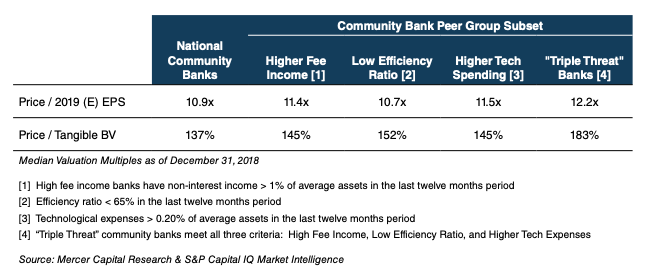
During our (Mercer Capital) session, Andy Gibbs and I argued for becoming a “triple threat” bank, noting that banks with higher fee income, superior efficiency ratios, and greater technology spending were being rewarded in the public market with better valuations all else equal (see table below). While we do not advocate for heavy tech spending as a means to an ill-defined objective, the evidence points to a superior valuation when technology is used to drive higher levels of fee income and greater operating leverage. For more information, view our slide deck.
Plan for the Good and Bad Times, Especially for the Bad Times

While there was a lot of discussion about an eventual slowdown in the economy and an inflection in the credit cycle, several sessions highlighted that a downturn will represent the best opportunity for those who are well prepared to grow. The key takeaway is to have a plan for both the good and the bad economic times to seize opportunity. Technology can play a role in a downturn by helping add customers at very low incremental costs.

Best Practices around Traditional M&A

On the M&A front, two M&A nuggets from attorneys stood out as well as a note about MOEs (mergers of equals):

  • Sullivan & Cromwell’s Rodgin Cohen suggested that buyers should determine what the counterparty wants and structure the transaction to achieve the counterparty’s objectives. Also, buyers need to “ride the circuit” to meet with potential acquisition candidates well before a decision to sell is made, while sellers need to know what they want to achieve before launching a sales process.
  • Howard & Howard’s Michael Bell, a leading attorney to credit unions, had an interesting session where he noted commercial bankers should actively court credit unions as potential acquirers in a marketing process because credit unions’ lower operating cost structures and tax-exempt status can produce a better cash price for the seller.
  • A few sessions discussed the potential for MOEs to create value for both banks’ shareholders through creating scale and by combining banks with different areas of strength. In addition, MOEs create an opportunity to upgrade technology while addressing costly legacy systems, including extensive branch networks. All three themes were addressed in two large MOEs announced in 2019 by TCF/Chemical and BB&T/SunTrust.

Conclusion

We will likely be back at AOBA next year and hope to see you there. In the meantime, if you have questions or wish to discuss a valuation or transaction need in confidence, don’t hesitate to contact us.

Continue Reading

April 2026 | The Community Bank Scale Tax: Three Questions for Boards in 2026
Bank Watch: April 2026

The Community Bank Scale Tax: Three Questions for Boards in 2026

Community banks came into 2026 in better shape than many expected. Margins and earnings improved, deposits were growing again, loan growth held up, and unrealized losses on securities moved lower. On the surface, the story looks better than a year ago. But that does not mean the pressure is gone.For many community banks, the next big issue is not only rates or loan growth. It is whether the bank is big enough, focused enough, and efficient enough to carry the higher cost of being a modern bank. That cost includes more than salaries and branches. It also includes technology, cybersecurity, vendor management, fraud tools, compliance, and the people needed to run it well. The FDIC’s Quarterly Banking Profile shows that despite better net interest margins, the largest drag on earnings is the cost of running a modern bank.That is where many board conversations should be headed now. The challenge is simple to describe: banking keeps getting more expensive, the cost base is harder to flex, and smaller banks do not always have enough scale to spread those costs out. This does not mean every bank needs to sell but it does mean every bank needs to be honest about what it costs to stay independent.1. Which costs are truly fixed, and which ones are self-inflicted?Every bank has unavoidable costs for non-revenue generating activities, such as for risk management, compliance, and cybersecurity. But not every cost deserves the same treatment.Some banks are carrying real fixed costs. Others are carrying years of built-up complexity: too many vendors, too many products, too many exceptions, too many legacy processes, and too many branches doing less work than they used to.The distinction between real fixed costs and the just-as-real complexity costs matters. If management treats every expense as untouchable, the bank usually ends up protecting complexity instead of protecting value. Boards should push on that point. Which costs are now part of the price of doing business? And which costs are there because nobody has made the harder cleanup decisions? Those are two very different problems.2. Are we big enough, or focused enough, to make the model work?Scale matters in banking, which is not a new point. The part that often gets missed is that scale does not always have to come from simply getting bigger. Scale can come from size. It can also come from focus.A bank with a strong niche, an efficient branch footprint, a manageable product set, and good expense discipline can often perform better than a larger bank carrying too much overhead. Bigger is not always better if the added size comes with added complexity.That is an important point for community bank boards. The question is not just, “Do we need to grow?” The better question is, “Do we have a business model that can carry the cost structure we have today?” If the answer is no, the bank has a few options: it can grow, it can simplify, it can narrow its focus, it can outsource more of what does not set it apart, or it can decide that another partner may be better positioned to carry the platform going forward.Recent examples show the range of choices. Community Bank used a branch purchase from Santander to build scale in a target market; Five Star Bank’s parent chose to wind down BaaS and refocus on its core franchise; Mechanics Bank exited indirect auto and later outsourced servicing of the run-off portfolio; and Susquehanna chose to partner with C&N for greater scale, resiliency, and efficiency. In sum, there are plenty of proven options and choices.But doing nothing is also a choice. And in many cases, it is the most expensive one.3. How much does the expense base hurt shareholder value?This is where strategy turns into valuation. A bank is not credited just for spending money on technology, compliance, or infrastructure. It gets credited when those investments lead to better performance, better returns, better customer retention, better growth, and better risk control.If the bank carries a heavy cost base without a clear payoff, that usually shows up in weaker earnings and lower returns. Over time, it can also show up in a lower valuation, which matters even if the board has no near-term interest in selling. Valuation is not just about a sale; it is a scorecard on the strength of the franchise. A bank with strong returns and a clear strategy usually has more flexibility. A bank with weaker returns and too much complexity usually has fewer options.Timing matters. Banks have more breathing room now than they did a few years ago when interest rates increased sharply, with strong earnings and clean asset quality, and that is a good time to revisit strategic and technological plans.The issue in 2026 is not simply whether a community bank can remain independent. The issue is whether it can earn that independence after paying the ever-growing cost of being a modern bank.The banks that will stand out are not necessarily the biggest banks. They are the ones that know what they do well, run a cleaner model, and make sure their cost base supports the franchise instead of weighing it down. For some institutions, that will support long-term independence. For others, it may lead to a different conclusion.Either way, the discussion should start with a hard look at the expense base. In a lot of cases, the pressure to sell does not begin with a buyer showing up. It begins when the math stops working.About Mercer CapitalMercer Capital is a nationally recognized valuation and advisory firm serving financial institutions including banks, credit unions, fintech companies, insurance companies, investment management firms, financial sponsors, and other specialty finance firms. Mercer Capital regularly assists these clients with significant corporate valuation requirements, transactional advisory services, and other strategic decisions.
March 2026 | Capital Allocation: The Strategic Decision in a Slower Growth Environment
Bank Watch: March 2026

Capital Allocation: The Strategic Decision in a Slower Growth Environment

Following several years of balance sheet volatility and margin pressure, the operating environment for banks improved in 2025 as most posted higher earnings on expanded net interest margins. The outlook for 2026, at least prior to the outbreak of the U.S./Israel-Iran war, reflects(ed) a relatively stable operating environment.Stability, however, introduces a different challenge. Loan growth has moderated across much of the industry, and the benefit from asset repricing has largely been realized. In this environment, earnings growth is less dependent on external tailwinds and more dependent on internal discipline. As a result, capital allocation has moved to the center of strategic decision-making.The Expanding Capital Allocation ToolkitCapital allocation discussions are often framed around dividends and, to a lesser extent, share repurchases. In practice, the range of capital deployment decisions is broader and more interconnected. Banks today are balancing:Organic balance sheet growthTechnology and infrastructure investmentDividendsShare repurchasesM&ABalance sheet repositioningRetained capital for flexibilityEach alternative carries different implications for risk, return, and long-term franchise value.Organic growth often is the preferred use for internally generated capital when the risk-adjusted returns exceed the cost of equity. However, competitive loan pricing and a tough environment to grow low cost deposits have narrowed spreads, reducing the margin for error. Similarly, technology investments may improve efficiency over time but require upfront capital with uncertain timing of returns.Returns, Valuation, and Market DisciplinePublic market valuations provide a useful lens for evaluating capital allocation decisions. As shown in Figure 1(on the next page), banks that generate higher returns on tangible common equity (ROTCE) tend to command higher price-to-tangible book value multiples. This can also be expressed algebraically, at least on paper, whereby P/E x ROTCE = P/TBV, while P/Es reflect investor assessments about growth and risk.This relationship reflects a straightforward principle: capital should be deployed where it earns returns in excess of the cost of equity. When internal opportunities meet that threshold, reinvestment should be appropriate. When returns are below the threshold, returning capital to shareholders through special dividends or repurchases may create greater per-share value.Share repurchases, in particular, can be an effective tool when executed below intrinsic value and when capital levels remain sufficient to support strategic flexibility. However, repurchases that do not improve per-share metrics or are offset by dilution from other sources may have limited impact.Figure 1: Publicly Traded Banks with Assets $1 to $5 BillionBalance Sheet Repositioning as Capital AllocationIn some cases, capital allocation decisions are embedded within the balance sheet itself. One example is securities portfolio repositioning.Many banks continue to hold securities originated during the low-rate environment of 2020 and 2021. While unrealized losses associated with these portfolios have moderated, the yield on these assets often remains well below current market rates.Repositioning the portfolio, by realizing losses and reinvesting at higher yields, represents a tradeoff between near-term capital impact and longer-term earnings improvement. In effect, this decision can be evaluated similarly to other capital deployment alternatives, with management weighing the upfront reduction in Tier 1 Capital against the expected lift to net interest income and returns over time.As with M&A, the concept of an “earnback period” can be applied. Institutions that approach repositioning with a clear understanding of the payback dynamics are better positioned to evaluate whether the strategy enhances long-term shareholder value. We offer the caveat that institutions who evaluate restructuring transactions should compare the expected return from realizing losses (i.e., reducing regulatory capital) with instead holding the securities and repurchasing shares. If the bank’s shares are sufficiently cheap, then it could make sense to continue to hold the underwater bonds until the shares rise sufficiently.M&A and Capital FlexibilityM&A remains a viable capital deployment option, particularly for institutions seeking scale or improved operating efficiency. However, transaction activity continues to be constrained by pricing discipline, tangible book value dilution, and investor expectations around earnback periods.Public market valuations ultimately serve as a governor on deal pricing, reinforcing the importance of aligning capital deployment decisions with shareholder return expectations.Conclusion: Discipline Drives OutcomesIn a slower growth environment, capital allocation is not a secondary consideration; it is a core driver of performance. While banks cannot control market multiples, they can control how capital is deployed across competing opportunities.Institutions that consistently allocate capital with a clear focus on risk-adjusted returns, strategic alignment, and per-share value creation are more likely to generate sustainable growth in earnings and tangible book value. In the current environment, disciplined execution may prove more valuable than more aggressive but less certain alternatives.
The Tariff Hangover: How a Year of Trade Volatility Is Reshaping Transportation
The past year has been defined by a series of rapid and often unpredictable shifts in trade policy. New tariffs, temporary pauses, retaliatory measures, and evolving global supply chains have left a measurable impact on the transportation and logistics industry. These developments have influenced freight volumes, pricing dynamics, capital allocation, and ultimately the valuation of transportation companies.

Cart

Your cart is empty