Corporate Valuation, Financial Services

December 4, 2019

Community Bank Valuation (Part 4): Valuing Minority Interests

In the June 2019 BankWatch we began a multi-part series exploring the valuation of community banks. The first segment introduced key valuation drivers: various financial metrics, growth, and risk. The second and third editions described the analysis of bank and bank holding company financial data with an emphasis on gleaning insights that affect the valuation drivers. We now conclude our series by assembling these pieces into the final product, a valuation of a specific bank.

While it would streamline the valuation process, there is no single value for a bank that is applicable to every conceivable scenario giving rise to the need for a valuation. Instead, valuation is context dependent. This edition of the series focuses on the valuation of minority interests in banks, which do not provide the ability to dictate control over the bank’s operations. The next edition focuses on valuation considerations applicable to controlling interests in banks that arise in acquisition scenarios.

Valuation Approaches

Valuation specialists identify three broad valuation approaches within which several valuation methods exist:

  1. The Asset Approach develops a value for a bank’s common equity based on the difference between its assets and liabilities, both adjusted to market value. This approach is less common in practice, given analysts’ focus on banks’ earnings capacity and market pricing data. In theory, a rigorous application of the asset approach would require determining the value of the bank’s intangible assets, such as its customer relationships, which introduces considerable complexity.
  2. The Market Approach provides indications of value by reference to actual transactions involving securities issued by comparable institutions. The obvious advantage of this approach is the coherence between the goal of the valuation itself (the derivation of market value) and the data used (market transactions). The disadvantage, though, is that perfectly comparable market data seldom exists. While we will not cover the topic in this article, transactions in the subject bank’s common stock, which often occur for privately held banks due to their frequently widespread ownership and stature in the community, may serve as another indication of value under the market approach.
  3. The Income Approach includes several methods that convert a cash flow stream (such as earnings or dividends) into a value. Two broad subsets of the income approach exist – single period capitalization methods and discounted cash flow methods. For bankers, a single period capitalization is analogous to a net operating income capitalization in a real estate appraisal; it requires an earnings metric and a capitalization multiple. Alternatively, bank valuations often use projection-based methodologies that convert a future stream of benefits into a value. The strengths and weaknesses of a projection-based methodology derive from a commonality – it requires a forecast of future performance. While creating such a forecast is consistent with the forward-looking nature of investor returns, predicting the future is, as they say, difficult.
The following discussion focuses on the valuation methodologies used most commonly for banks, the comparable company method and the discounted cash flow method.

Comparable Company Method

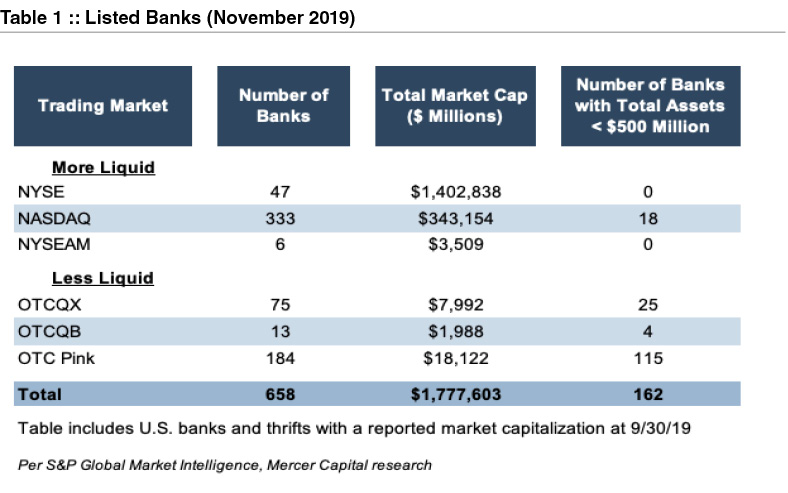
Bank analysts are awash in data, both regarding banks’ financial performance but also market data regarding publicly traded banks’ valuation. Table 1 presents a breakdown by trading market of the number of listed banks in November 2019.
To narrow this surfeit of comparable company data, analysts often screen the publicly traded bank universe based on characteristics such as the following:
  • Size, such as total assets or market capitalization
  • Profitability, such as return on assets or return on equity
  • Location
  • Asset quality
  • Revenue mix, such as the proportion of revenue from loan sales or asset management fees
  • Balance sheet composition, such as the proportion of loans or dependence on wholesale funding
  • Trading market or volume
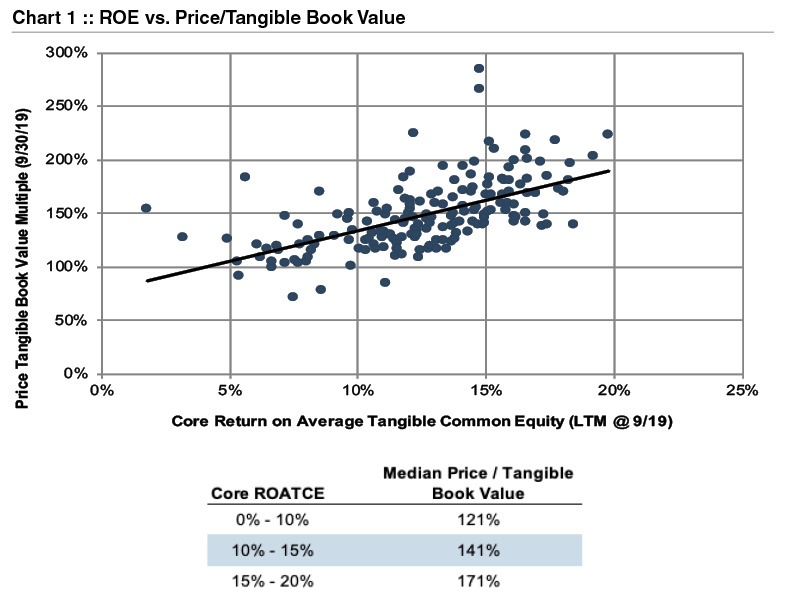
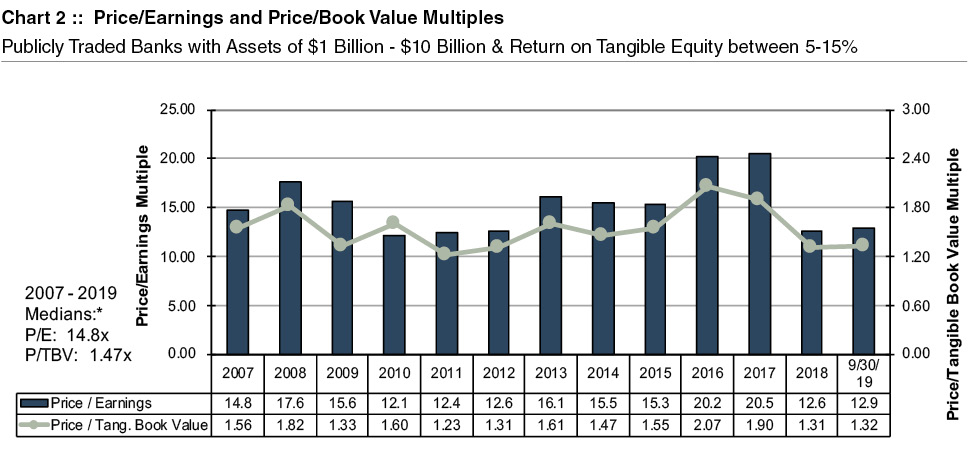
Even after applying screens similar to the preceding, it remains doubtful that the publicly traded banks will exactly mirror the subject bank’s characteristics. This is especially true when valuing smaller community banks, as a relatively limited number of publicly traded banks exist with assets of less than $500 million that trade in more liquid markets. Ultimately, the analyst must determine an appropriate valuation multiple based on the subject bank’s perceived growth opportunities and risk attributes relative to the public companies. For example, analysts can compare the subject bank’s historical and projected EPS growth rates against the public companies’ EPS growth rates, with a materially lower growth outlook for the subject bank suggesting a lower pricing multiple. Part 1 of this community bank valuation series described various valuation metrics applicable to banks, most prominently earnings and tangible book value. It is important to reiterate that while bankers and analysts often reference price/tangible book value multiples, the earning power of the institution drives its value. Chart 1 illustrates this point, showing that price/tangible book value multiples rise along with the core return on tangible common equity. This chart includes banks traded on the NASDAQ, NYSE, or NYSEAM with assets between $1 and $10 billion. Since banking is a more mature industry, bank price/earnings multiples tend to vary within a relatively tight range. Chart 2 provides some perspective on historical price/earnings and price/tangible book value multiples, which includes banks traded on the NASDAQ, NYSE, or NYSEAM with assets between $1 and $10 billion and a return on core tangible common equity between 5% and 15%. Trading multiples in the first several years of the analysis may be distorted by recessionary conditions, while the multiples reported for 2016 and 2017 were exaggerated by optimism regarding the potential, at that time, for tax and regulatory reform. The diminished multiples at yearend 2018 and September 30, 2019 reflect a challenging interest rate environment, marked by a flat to inverted yield curve, and the possibility for rising credit losses in a cooling economy.
Discounted Cash Flow Method

The discounted cash flow (DCF) method relies upon three primary inputs:

  • A projection of cash flows distributable to investors over a finite time period » A terminal, or residual, value representing the value of all cash flows occurring after the end of the finite forecast period
  • A discount rate to convert the discrete cash flows and terminal value to present value

1. Cash Flow

First, a few suggestions regarding projections:

  • For a financial institution, projecting an income statement without a balance sheet usually is inadvisable, as this obscures important linkages between the two financial statements. For example, the bank’s projected net interest income growth may require a level of loan growth not permitted by the bank’s capital resources.
  • Including a roll-forward of the loan loss reserve illustrates key asset quality metrics, such as the ratios of loan charge-offs to loans and loan loss reserves to loans. The level of charge-offs should be assessed against the bank’s historical performance and the economic outlook.
  • Key financial metrics, both for the balance sheet and income statement, should be assessed against the bank’s historical performance and peer banks.
  • While projections can be prepared on a consolidated basis, we prefer developing separate projections for the bank and its holding company. This makes explicit the relationships between the two entities, such as the holding company’s reliance on the bank for cash flow. For leveraged holding companies, a sources and uses of funds schedule is useful.
In preparing a DCF analysis for a bank, the most meaningful cash flow measure is distributable tangible equity. The analyst sets a threshold ratio of tangible common equity/tangible assets or another regulatory capital ratio based on management’s expectations, regulatory requirements, and/or peer and publicly traded comparable company levels. Equity generated by the bank above this target level is assumed to be distributed to the holding company. After determining the holding company’s expenses and debt service requirements, the remaining amount represents shareholder cash flow, which then is captured in the DCF valuation analysis.

2. Discount Rate

For a financial institution, the discount rate represents the entity’s cost of equity. Outside the financial services industry, analysts most commonly employ a weighted average cost of capital (WACC) as the discount rate, which blends the cost of the company’s debt and equity funding. However, banks are unique in that most of their funding comes from deposits, and the cost of deposits does not rise along with the entity’s risk of financial distress (because of FDIC insurance). Therefore, a significant theoretical underpinning for using a WACC – that the cost of debt increases along with the entity’s risk of default – is undermined for a bank. Analytical consistency is created in a DCF analysis by matching a cash flow to equity investors (i.e., dividends) with a cost of equity.

A bank’s cost of equity can be estimated based on the historical excess returns generated by equity investments over Treasury rates, as adjusted by a “beta” metric that captures the volatility of bank stocks relative to the broader market. Analysts may also consider entity-specific risk factors – such as a concentration in a limited geographic market, elevated credit quality concerns, and the like – that serve to distinguish the risk faced by investors in the subject institution relative to the norm for publicly traded banks from which cost of equity data is derived.

3. Terminal Value

The terminal value is a function of a financial metric at the end of the forecast period, such as net income or tangible book value, and an appropriate valuation multiple. Two techniques exist to determine a terminal value multiple. First, the Gordon Growth Model develops an earnings multiple using (a) the discount rate and (b) a long-term, sustainable growth rate. Second, as illustrated in Chart 2, bank pricing multiples tend to vary within a relatively tight range, and a historical average trading multiple can inform the terminal value multiple selection.

Correlating the Analysis

In most analyses, the values derived using the market and income approaches will differ. Given a range, an analyst must consider the strengths and weaknesses of each indicated value to arrive at a final concluded value. For example, earnings based indications of value derived using the market approach may be more relevant in “normal” times, as the values are consistent with investors’ orientation towards earnings as the ultimate source of returns (either dividends or capital appreciation). However, in more distressed times when earnings are depressed, indications of value using book value assume more relevance. If a bank has completed a recent acquisition or is in the midst of a strategic overhaul, then the discounted cash flow method may deserve greater emphasis. We prefer to assign quantitative weights to each indication of value, which provide transparency into the process by which value is determined.

Relative Value Analysis

The analysis is not complete, however, when a correlated value is obtained. It is crucial to compare the valuation multiples implied by the concluded value, such as the effective price/earnings and price/tangible book value multiples, against those reported by publicly traded banks. Any divergences should be explainable. For example, if the bank operates in a market with constrained growth prospects, then a lower than average price/earnings multiple may be appropriate. A higher return on equity for a subject bank, relative to the comparable companies, often results in a higher price/tangible book value multiple. As another reference point, the effective pricing multiples may be benchmarked against bank merger and acquisition pricing to ensure that an appropriate relationship exists between the subject minority interest value and a possible merger value.

Conclusion

There are many valuation issues that remain untouched by this article in the interest of brevity, such as the valuation treatment of S corporations and the discount for lack of marketability applicable to minority interests in banks with no active trading market. Instead, this article addresses issues commonly faced in valuing minority interests in any community bank. A well-reasoned valuation of a community bank requires understanding the valuation conventions applicable to banks, such as pricing multiples commonly employed or the appropriate source of cash flow in a DCF analysis, but within a risk and growth framework that underlies the valuation of all equity instruments. Relating these valuation parameters to a comprehensive analysis of a bank’s financial performance, risk factors, and strategic outlook results in a rigorous and convincing determination of value. In the next edition, we will move beyond the valuation of minority interests in banks, focusing on specific valuation nuances that arise when engaging in a valuation for merger purposes.


Originally published in Bank Watch, November 2019.

Continue Reading

April 2026 | The Community Bank Scale Tax: Three Questions for Boards in 2026
Bank Watch: April 2026

The Community Bank Scale Tax: Three Questions for Boards in 2026

Community banks came into 2026 in better shape than many expected. Margins and earnings improved, deposits were growing again, loan growth held up, and unrealized losses on securities moved lower. On the surface, the story looks better than a year ago. But that does not mean the pressure is gone.For many community banks, the next big issue is not only rates or loan growth. It is whether the bank is big enough, focused enough, and efficient enough to carry the higher cost of being a modern bank. That cost includes more than salaries and branches. It also includes technology, cybersecurity, vendor management, fraud tools, compliance, and the people needed to run it well. The FDIC’s Quarterly Banking Profile shows that despite better net interest margins, the largest drag on earnings is the cost of running a modern bank.That is where many board conversations should be headed now. The challenge is simple to describe: banking keeps getting more expensive, the cost base is harder to flex, and smaller banks do not always have enough scale to spread those costs out. This does not mean every bank needs to sell but it does mean every bank needs to be honest about what it costs to stay independent.1. Which costs are truly fixed, and which ones are self-inflicted?Every bank has unavoidable costs for non-revenue generating activities, such as for risk management, compliance, and cybersecurity. But not every cost deserves the same treatment.Some banks are carrying real fixed costs. Others are carrying years of built-up complexity: too many vendors, too many products, too many exceptions, too many legacy processes, and too many branches doing less work than they used to.The distinction between real fixed costs and the just-as-real complexity costs matters. If management treats every expense as untouchable, the bank usually ends up protecting complexity instead of protecting value. Boards should push on that point. Which costs are now part of the price of doing business? And which costs are there because nobody has made the harder cleanup decisions? Those are two very different problems.2. Are we big enough, or focused enough, to make the model work?Scale matters in banking, which is not a new point. The part that often gets missed is that scale does not always have to come from simply getting bigger. Scale can come from size. It can also come from focus.A bank with a strong niche, an efficient branch footprint, a manageable product set, and good expense discipline can often perform better than a larger bank carrying too much overhead. Bigger is not always better if the added size comes with added complexity.That is an important point for community bank boards. The question is not just, “Do we need to grow?” The better question is, “Do we have a business model that can carry the cost structure we have today?” If the answer is no, the bank has a few options: it can grow, it can simplify, it can narrow its focus, it can outsource more of what does not set it apart, or it can decide that another partner may be better positioned to carry the platform going forward.Recent examples show the range of choices. Community Bank used a branch purchase from Santander to build scale in a target market; Five Star Bank’s parent chose to wind down BaaS and refocus on its core franchise; Mechanics Bank exited indirect auto and later outsourced servicing of the run-off portfolio; and Susquehanna chose to partner with C&N for greater scale, resiliency, and efficiency. In sum, there are plenty of proven options and choices.But doing nothing is also a choice. And in many cases, it is the most expensive one.3. How much does the expense base hurt shareholder value?This is where strategy turns into valuation. A bank is not credited just for spending money on technology, compliance, or infrastructure. It gets credited when those investments lead to better performance, better returns, better customer retention, better growth, and better risk control.If the bank carries a heavy cost base without a clear payoff, that usually shows up in weaker earnings and lower returns. Over time, it can also show up in a lower valuation, which matters even if the board has no near-term interest in selling. Valuation is not just about a sale; it is a scorecard on the strength of the franchise. A bank with strong returns and a clear strategy usually has more flexibility. A bank with weaker returns and too much complexity usually has fewer options.Timing matters. Banks have more breathing room now than they did a few years ago when interest rates increased sharply, with strong earnings and clean asset quality, and that is a good time to revisit strategic and technological plans.The issue in 2026 is not simply whether a community bank can remain independent. The issue is whether it can earn that independence after paying the ever-growing cost of being a modern bank.The banks that will stand out are not necessarily the biggest banks. They are the ones that know what they do well, run a cleaner model, and make sure their cost base supports the franchise instead of weighing it down. For some institutions, that will support long-term independence. For others, it may lead to a different conclusion.Either way, the discussion should start with a hard look at the expense base. In a lot of cases, the pressure to sell does not begin with a buyer showing up. It begins when the math stops working.About Mercer CapitalMercer Capital is a nationally recognized valuation and advisory firm serving financial institutions including banks, credit unions, fintech companies, insurance companies, investment management firms, financial sponsors, and other specialty finance firms. Mercer Capital regularly assists these clients with significant corporate valuation requirements, transactional advisory services, and other strategic decisions.
March 2026 | Capital Allocation: The Strategic Decision in a Slower Growth Environment
Bank Watch: March 2026

Capital Allocation: The Strategic Decision in a Slower Growth Environment

Following several years of balance sheet volatility and margin pressure, the operating environment for banks improved in 2025 as most posted higher earnings on expanded net interest margins. The outlook for 2026, at least prior to the outbreak of the U.S./Israel-Iran war, reflects(ed) a relatively stable operating environment.Stability, however, introduces a different challenge. Loan growth has moderated across much of the industry, and the benefit from asset repricing has largely been realized. In this environment, earnings growth is less dependent on external tailwinds and more dependent on internal discipline. As a result, capital allocation has moved to the center of strategic decision-making.The Expanding Capital Allocation ToolkitCapital allocation discussions are often framed around dividends and, to a lesser extent, share repurchases. In practice, the range of capital deployment decisions is broader and more interconnected. Banks today are balancing:Organic balance sheet growthTechnology and infrastructure investmentDividendsShare repurchasesM&ABalance sheet repositioningRetained capital for flexibilityEach alternative carries different implications for risk, return, and long-term franchise value.Organic growth often is the preferred use for internally generated capital when the risk-adjusted returns exceed the cost of equity. However, competitive loan pricing and a tough environment to grow low cost deposits have narrowed spreads, reducing the margin for error. Similarly, technology investments may improve efficiency over time but require upfront capital with uncertain timing of returns.Returns, Valuation, and Market DisciplinePublic market valuations provide a useful lens for evaluating capital allocation decisions. As shown in Figure 1(on the next page), banks that generate higher returns on tangible common equity (ROTCE) tend to command higher price-to-tangible book value multiples. This can also be expressed algebraically, at least on paper, whereby P/E x ROTCE = P/TBV, while P/Es reflect investor assessments about growth and risk.This relationship reflects a straightforward principle: capital should be deployed where it earns returns in excess of the cost of equity. When internal opportunities meet that threshold, reinvestment should be appropriate. When returns are below the threshold, returning capital to shareholders through special dividends or repurchases may create greater per-share value.Share repurchases, in particular, can be an effective tool when executed below intrinsic value and when capital levels remain sufficient to support strategic flexibility. However, repurchases that do not improve per-share metrics or are offset by dilution from other sources may have limited impact.Figure 1: Publicly Traded Banks with Assets $1 to $5 BillionBalance Sheet Repositioning as Capital AllocationIn some cases, capital allocation decisions are embedded within the balance sheet itself. One example is securities portfolio repositioning.Many banks continue to hold securities originated during the low-rate environment of 2020 and 2021. While unrealized losses associated with these portfolios have moderated, the yield on these assets often remains well below current market rates.Repositioning the portfolio, by realizing losses and reinvesting at higher yields, represents a tradeoff between near-term capital impact and longer-term earnings improvement. In effect, this decision can be evaluated similarly to other capital deployment alternatives, with management weighing the upfront reduction in Tier 1 Capital against the expected lift to net interest income and returns over time.As with M&A, the concept of an “earnback period” can be applied. Institutions that approach repositioning with a clear understanding of the payback dynamics are better positioned to evaluate whether the strategy enhances long-term shareholder value. We offer the caveat that institutions who evaluate restructuring transactions should compare the expected return from realizing losses (i.e., reducing regulatory capital) with instead holding the securities and repurchasing shares. If the bank’s shares are sufficiently cheap, then it could make sense to continue to hold the underwater bonds until the shares rise sufficiently.M&A and Capital FlexibilityM&A remains a viable capital deployment option, particularly for institutions seeking scale or improved operating efficiency. However, transaction activity continues to be constrained by pricing discipline, tangible book value dilution, and investor expectations around earnback periods.Public market valuations ultimately serve as a governor on deal pricing, reinforcing the importance of aligning capital deployment decisions with shareholder return expectations.Conclusion: Discipline Drives OutcomesIn a slower growth environment, capital allocation is not a secondary consideration; it is a core driver of performance. While banks cannot control market multiples, they can control how capital is deployed across competing opportunities.Institutions that consistently allocate capital with a clear focus on risk-adjusted returns, strategic alignment, and per-share value creation are more likely to generate sustainable growth in earnings and tangible book value. In the current environment, disciplined execution may prove more valuable than more aggressive but less certain alternatives.
The Tariff Hangover: How a Year of Trade Volatility Is Reshaping Transportation
The past year has been defined by a series of rapid and often unpredictable shifts in trade policy. New tariffs, temporary pauses, retaliatory measures, and evolving global supply chains have left a measurable impact on the transportation and logistics industry. These developments have influenced freight volumes, pricing dynamics, capital allocation, and ultimately the valuation of transportation companies.

Cart

Your cart is empty